Crypto Points Programs Are a Loan From Your Community
A crypto points program borrows attention now and repays it later in tokens. From EigenLayer to Blast, here is what repayment day looks like and how to run points without the crash that usually follows.
Key takeaways
A crypto points program works like a loan, because users lend attention and capital now against a token payout the project promises later, and Whales Market traded $44 million of those IOUs within weeks of launching in 2024.
Repayment day is usually brutal, with Keyrock finding 88% of 2024's airdropped tokens fell and Blast losing 97% of its deposits after its points campaign paid out.
The protocols holding value in 2026 pay holders out of revenue instead, and Hyperliquid had repurchased about $1.3 billion of its own token with trading fees between December 2024 and the end of August 2026.
Every crypto points program borrows attention now and promises to pay it back later, usually in a token that doesn't exist yet. Traders understood this before most founders did. In early 2024 a marketplace called Whales Market did $44 million in trading volume within weeks of launching, and among its listings were markets for EigenLayer points and Hyperliquid points, which means people were buying and selling reward points for tokens nobody had seen. Once your points have a secondary market, your IOUs have a price, and whatever you meant when you launched the campaign, the market has already filed it under debt.
Debt isn't a dirty word, and companies borrow to grow all the time. The way we'd put it at AnkhLabs is that a loan has a lender, an interest rate and a repayment date, and the protocols that treated points as free engagement instead of borrowed engagement have spent two years learning what a default looks like. The record from EigenLayer to Blast shows the pattern clearly, and it also shows the few teams that borrowed well.
The community is the lender, the airdrop is the repayment, and the market sets the interest rate whether you like it or not.
What is a crypto points program?
A crypto points program is a scoreboard a protocol keeps offchain, awarding points for deposits, trades, referrals or daily activity, with the implied promise that those points will later convert into a token airdrop. It works like a loyalty program with no published exchange rate, so users are lending time and capital against a payout nobody has priced yet.
That missing exchange rate is what separates a points program from a crypto loyalty program in the airline-miles sense. An airline tells you roughly what a flight costs in miles before you start flying, while most points programs reveal the conversion only at the end, after the lending has already happened. The format became the default in 2023 and 2024 because it let teams count users before they had a token, and because it kept money parked in the protocol while everyone waited for the snapshot, the moment a project records balances to decide who gets paid.
How does points farming work?
Points farming means doing whatever a points program rewards at the lowest possible cost, purely to collect the eventual airdrop. Serious farmers split their activity across hundreds or thousands of wallets, cycle the same capital through deposits to multiply their points, and sell the token the day it arrives, because the payout was the only reason they came.
Those wallets show up on the dashboard as users and as deposits, which is why points programs look so healthy while they run. Tiger Research measured what happens afterwards across a group of points-farmed protocols, including one bridge whose volume fell 75% after the snapshot and one ecosystem where 78% of six million wallets were judged fake or farming. It is the same behaviour we described in how liquidity mining attracts mercenary capital, with the reward moved from a live token to a promised one.
Points vs airdrop: what happens on repayment day?
Points are the promise and the airdrop is the payment, so the airdrop is the day the loan gets settled. When the terms disappoint, depositors leave before the token even trades, and when the token does arrive most recipients sell. Keyrock's study of 2024's airdrops found 88% of the tokens fell, with most of the damage inside the first fifteen days.
Start with what happens when lenders don't like the terms. In April 2024 EigenLayer, the protocol that lets people reuse staked ether to secure other networks, revealed an airdrop with a token that couldn't be transferred and was blocked in many countries. Within three days more than 12,400 withdrawal requests had queued up, with about one in nine depositors heading for the exit before the token had even moved. That was lenders reacting to a bad repayment offer rather than users rejecting a product.
When repayment does arrive on schedule, the pattern is just as clean. The analytics firm Nansen tracked zkSync's airdrop and found 41% of recipient wallets sold everything, another 29% sold part, and the token dropped 34.5% within days. There are ways to keep more of that value inside your ecosystem, which we covered in our guide to airdrop marketing and value capture, but none of them work if the lenders never wanted your product in the first place.
Blast and friend.tech ran the full credit cycle
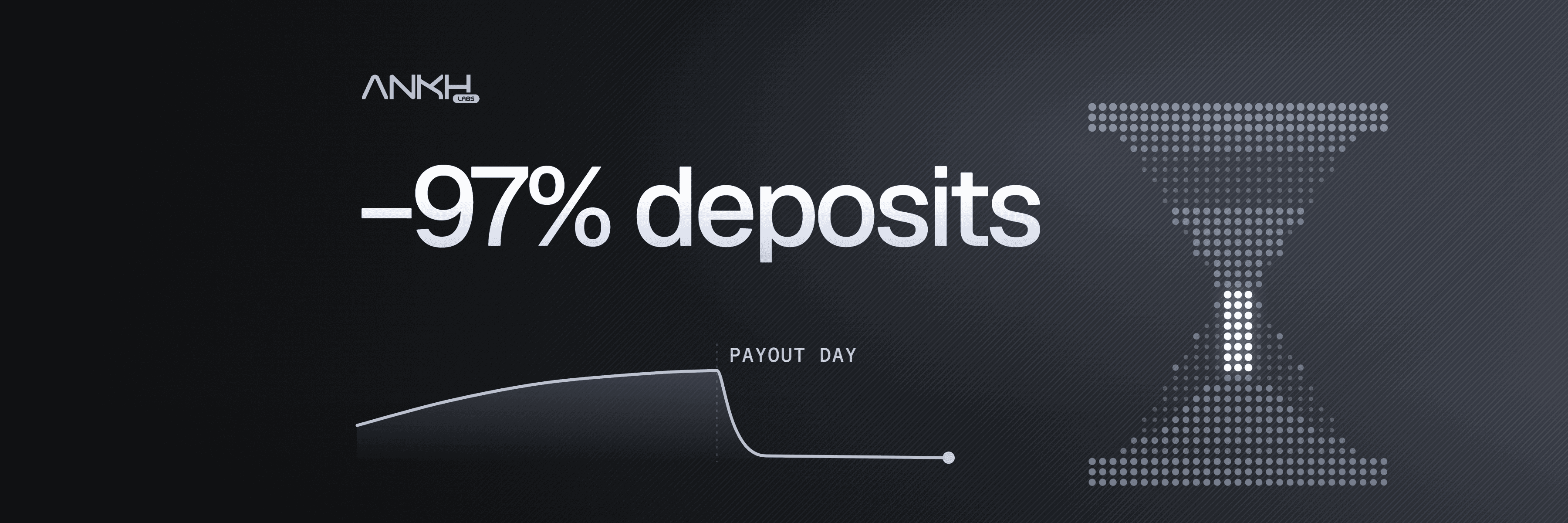
No project shows the whole arc like Blast, the Ethereum layer 2 network that launched with points, referrals and a countdown timer. It borrowed harder than anyone and it worked right up until the debt came due. Deposits peaked at $2.3 billion in June 2024, and within two months of the airdrop they were down more than 60% while daily users sank to about 30,000. A year later the books were closed, with deposits down 97% to $65 million, about 3,500 daily users and the token down 91%.
friend.tech, the social app that sold access to people's private chat rooms, ran the purest borrow-attention experiment of the era and showed the terminal version, with deposits down 92% from peak, the token down 98%, and the whole thing shut down. None of these teams were bad at generating activity, since they generated historic amounts of it. They mistook borrowed demand for real demand, and the difference only became visible on the day the loan was repaid.
Why the market moved from points to buybacks
The lenders learned faster than the borrowers, and appetite for the next points-to-token cycle thinned out. By 2025 DL News was writing about "layer 2 token fatigue," with Scroll's token down 72% since launch as Linea's long-awaited airdrop approached. Meanwhile the standout protocol of the cycle ran the opposite model, which we covered in our breakdown of Hyperliquid's growth strategy. Hyperliquid, the onchain exchange for perpetual futures (contracts that let traders bet on prices with no expiry date), uses 97% of its accumulated fees, raised to 99% for some fee categories by a December 2025 vote, to buy its own token on the open market. Those purchases had reached about $1.3 billion since December 2024 when Crypto Briefing reported the figure on 31 August 2026.
The rest of the market followed the money. Crypto projects spent $638 million on token buybacks between January and the end of August 2026, 17% more than in the same months of 2025, according to Allium Labs data, with Hyperliquid and Pump.fun accounting for nearly 90% of it. Investors now reward what a protocol pays out of real revenue, and they discount what it merely owes.
What we'd tell a founder about running a crypto points program
Borrow from people who were staying anyway. Tiger Research's one success story was Jito, the Solana staking protocol, whose airdrop rewarded existing, real usage and whose deposits grew 63% afterward. A reward that lands on genuine users works like a dividend, while a reward that summons farmers is a loan from people who were never going to stay. The same principle sat behind the points-driven engagement programme AnkhLabs worked on for Mythical Forest, where rewards were tied to sustained activity and the programme reached 1M+ users onboarded and 10M+ campaign impressions, as reported by client and platform data.
Read your points price like a credit rating. If traders are pricing your points on a pre-market, compare that price with what you actually plan to pay out. When farmers value the claim above your planned repayment, the sell-off is already scheduled, and you're the only one in the trade who doesn't know it.
Set the repayment terms before the borrowing starts. EigenLayer's crisis came from terms revealed late, which lenders read as a haircut, rather than from the size of the airdrop. Eligibility, transfer rules and timing announced at the end of a campaign will always feel like a rug pull, while the same terms announced at the start read as a contract.
Pay with revenue instead of promises. A buyback funded by real fees is a payout you control and can size to what the business earns. A points balance is a liability that grows with every farmer who joins and comes due in one lump on the worst possible day, so strip out the fake wallets before you pay anyone, because every fake account you reward is money taken from a real user.
Borrowed growth, honestly accounted
The points meta wasn't stupid, because borrowing demand to kickstart a network is a legitimate move and a few teams did it well. What the last two years condemn is borrowing without accounting, with no ledger of what was owed, no plan for repayment day and no line between lenders and users. Run a crypto points program like a CFO and it can still buy you a network, but run it like free money and the numbers above become your repayment schedule. You can see how we approach reward programmes in our case studies and on our community building and management page. If you're designing a crypto points program and want a second opinion on the terms before you launch, talk to AnkhLabs.
Frequently asked questions
What are crypto points?
Crypto points are rewards a protocol tracks offchain for actions like depositing, trading or referring friends, usually with an unstated promise that they will convert into a token airdrop later. They have no fixed value, but traders still price them, and Whales Market did $44 million in volume within weeks in 2024 partly by trading points before any token existed.
Is points farming profitable?
It depends almost entirely on repayment terms, which most programs reveal late. The data on the 2024 cycle is discouraging for anyone who holds, since Keyrock found 88% of airdropped tokens fell after launch, mostly within fifteen days. Farmers who profit usually sell on the first day, which is exactly why the price falls for everyone else.
What is the difference between points and an airdrop?
Points are the promise and the airdrop is the payment. A points program records activity over weeks or months, and the airdrop converts that record into tokens at a rate the project chooses, often announced only at the end. That delay is why the announcement matters so much, as EigenLayer learned when more than 12,400 withdrawal requests queued within three days of its reveal.
Is a crypto points program the same as a loyalty program?
Only loosely. A traditional loyalty program, like airline miles, tells members roughly what points are worth and rewards customers who were already buying. Most crypto points programs hide the exchange rate until the end and attract users who come only for the payout, which is why Blast's deposits fell 97% once its airdrop was done.
What do successful points programs do differently?
They reward real usage that existed before the campaign, publish their terms early and pay out of revenue where they can. Jito's airdrop went mainly to existing users and its deposits grew 63% afterward, while Hyperliquid followed its airdrop by routing 97% to 99% of its trading fees into buying back its own token.